
CIS-3-Hexenyl Caproate
- Home
- /
- CIS-3-Hexenyl Caproate


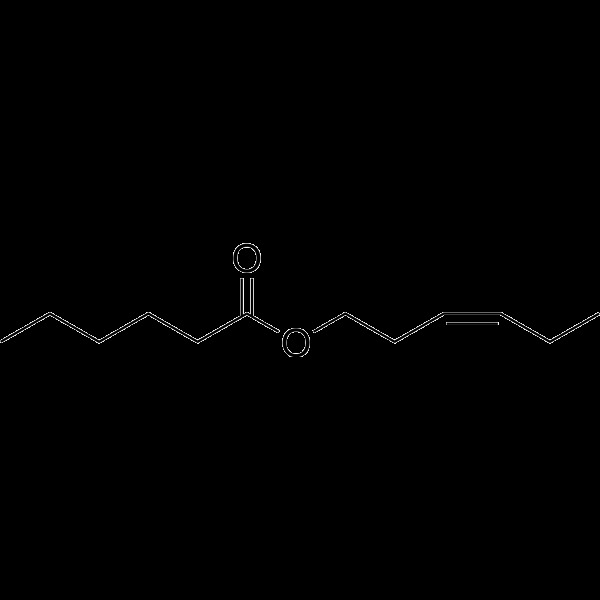
Kelvin Natural Mint is one of the most dependable CIS-3-Hexenyl Caproate Manufacturers in India, supplying this green-fruity aroma ester to fragrance houses, flavour companies, and personal care manufacturers across India and international markets. We produce and supply this material with GC-tested purity, consistent batch quality, and full regulatory documentation at every order.
Among all the CIS-3-hexenyl esters, this one is the easiest to underestimate on paper and the hardest to ignore in an actual blend. It opens on a pear fruit, then pineapple, with a waxy softness behind both. The green grass note is present, but it comes third, maybe fourth. That ordering is unusual for this family, and it is precisely what makes the caproate useful where the acetate or butyrate would push a composition too far into the herbal-green direction. You get the naturalness of leaf alcohol without the sharp cut-grass dominance. The longer hexanoic acid chain seems to do that.
Technical Specification
| Property | Specification |
| Product Name | CIS-3-Hexenyl Caproate |
| Synonyms | Cis-3-Hexenyl Hexanoate; (Z)-3-Hexenyl Hexanoate; (Z)-Hex-3-enyl Hexanoate; Hexanoic Acid (3Z)-3-Hexenyl Ester; N-Caproic Acid Cis-3-Hexen-1-yl Ester; cis-β-Hexenyl Caproate |
| Status | Synthetic |
| Molecular Formula | C₁₂H₂₂O₂ |
| Molecular Weight | 198.30 g/mol |
| CAS Number | 31501-11-8 |
| FEMA | 3403 |
| JECFA | 165 |
| EINECS | 250-661-6 |
| Colour | Colourless to almost colourless clear liquid |
| Odour | Strong green, fruity, winey |
| Taste | Green, fruity, waxy, sweet berry and tropical nuance at 20 ppm |
| Density | 0.880 g/mL at 25°C |
| Refractive Index | n20/D 1.473 |
| Flash Point | 220°F (approx. 104°C) |
| Boiling Point | 115°C at 15 mm Hg |
| Solubility | Practically insoluble in water; soluble in alcohol, propylene glycol, and oils |
| Natural Occurrence | Green tea, guava, passion fruit, orange peel, corn mint oil, plum, mango, nectarine, quince |
| Packaging | 25 Kgs – GI Cans, GI Barrels, Aluminium Bottles |
| Storage | Sealed, inert atmosphere, room temperature, away from light and heat |
Get In Touch
How Cis-3-Hexenyl Caproate Is Produced and Why Cis Purity Matters
It is produced by azeotropic esterification of CIS-3-Hexenol, commonly known as leaf alcohol, with n-hexanoic acid. The cis isomer constitutes a minimum of 98% of the finished product, and that figure is not a formality. The trans form carries almost none of the olfactory character that makes this ester worth specifying. A supplier who does not control that ratio consistently is delivering a weaker, less predictable version of the same ingredient, something that only becomes obvious once you are already mid-formulation.
The natural occurrence data deserves a proper read, too. This compound has been reported in green tea, guava, passion fruit, orange peel oil, corn mint oil, plum, mango, nectarine, and quince. That spread across such varied sources tells a formulator exactly how wide the application range can be without losing credibility. It belongs in tropical accords because it actually occurs there. It works in green tea flavours for the same reason. Nature already validated these combinations.
Fragrance and Flavour Applications of CIS-3-Hexenyl Caproate
In fragrance, pear-pineapple topnote complexes are its most consistent home. It settles naturally into those accords and does not compete with surrounding materials for attention. Galbanum and tomato leaf compositions benefit from careful additions of this ester; the fruity ripeness quietly softens what can otherwise read as sharp or medicinal. Watery and dewy florals gain an outdoor naturalness from it that purely aromatic synthetic ingredients rarely replicate in the same way.
Dosage is where discipline counts. This material diffuses well beyond what its usage level suggests. Most experienced perfumers keep it below 0.8% in fine fragrance bases and evaluate on a strip before pushing further. Above that threshold, it can take over an accord faster than expected.
On the flavour side, FEMA 3403 and JECFA 165 clearances cover standard food-grade applications, such as beverages, confectionery, dairy, and bakery products, among them. Passion fruit, guava, pear, tropical blends, and green tea profiles respond to it best. At around 20 ppm, the taste profile reads as green, fruity, waxy, and sweet, with a distinct berry-tropical nuance. It is clean and effective at low doses and easy to overdo if that discipline slips.
Trusted CIS-3-Hexenyl Caproate Suppliers and Exporters from India
If you are looking for a reliable CIS-3-Hexenyl Caproate Suppliers and Exporters in India for domestic supply or international Export, we are ready to assist. Samples are available on request before any commercial commitment is made. Share your requirement with our team, and we will respond promptly.
Related Products




Proven. Approved. Certified.








Copyright © 2026 Kelvin Natural Mint Pvt. Ltd. | All Rights Reserved. Website Designed & SEO By Webclick® Digital Pvt. Ltd. Website Designing Company India.
